Introduction
Businesses have used automation for years to reduce repetitive work, improve efficiency, and connect different systems.
Traditional automation works well when a process follows clear and predictable rules. But modern business processes are often more complex. Employees may need to read information, understand context, make decisions, and choose what should happen next.
This is where AI agents are becoming important.
AI agents can understand a goal, work with information, use connected tools, and decide which actions are needed to complete a task.
So, what is the difference between AI agents and traditional automation?
What is traditional automation?
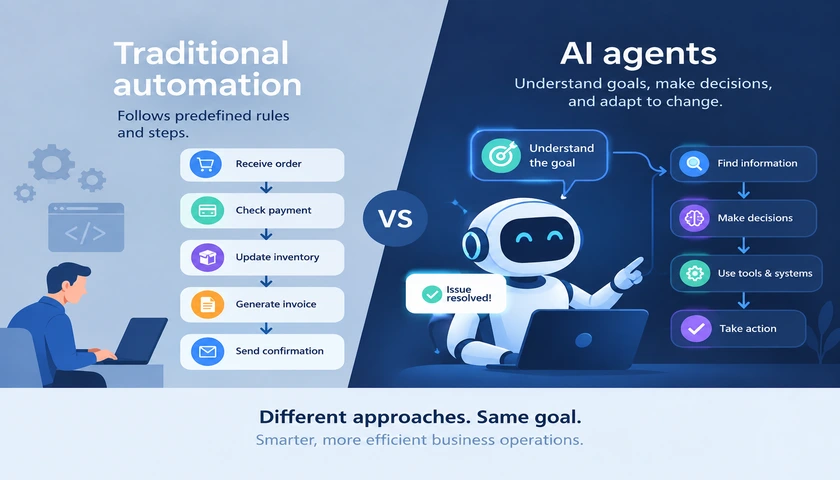
Traditional automation follows predefined instructions.
For example:
New order → verify payment → update inventory → create invoice → send confirmation
Every step is already defined in the workflow.
Traditional automation is useful for tasks such as:
- Sending notifications
- Processing invoices
- Updating customer records
- Synchronizing data
- Generating reports
- Managing approvals
- Updating inventory
- Running scheduled processes
It works particularly well when the same input should consistently produce the same result.
What are AI agents?
AI agents work toward a goal rather than simply following one fixed sequence of steps.
For example, imagine a customer sends:
“My order arrived damaged and I need a replacement before Friday.”
An AI agent could understand the request, check the order, review the replacement policy, check product availability, and determine the next appropriate action.
The process can change depending on what the agent discovers.
This makes AI agents useful for business tasks involving:
- Unstructured information
- Customer conversations
- Documents
- Research
- Multiple systems
- Different possible outcomes
- Context-based decisions
AI agents vs traditional automation
| Area | Traditional automation | AI agents |
|---|---|---|
| Process | Predefined | Goal-driven |
| Decisions | Rules and conditions | Context-based |
| Workflow | Mostly fixed | Can adapt |
| Input | Usually structured | Structured and unstructured |
| Best for | Repetitive tasks | Variable and complex tasks |
| Predictability | High | Can vary |
| Human involvement | Handles exceptions | Can be included for approvals |
The key difference is simple:
Traditional automation follows the process. AI agents can determine the next step required to achieve a goal.
When traditional automation makes sense
Not every process needs AI.
Traditional automation can be the better fit when:
- The process is predictable.
- Business rules are clearly defined.
- The same steps are repeated frequently.
- Inputs are structured.
- Consistency is more important than flexibility.
For example, generating an invoice after a successful payment does not necessarily require an AI agent. A standard automated workflow can handle it efficiently.
When AI agents make sense
AI agents become more useful when a process requires interpretation or decision-making.
For example, a customer support agent may need to understand a customer’s problem, review previous conversations, check account information, find relevant information, and decide whether the issue can be resolved automatically or should be sent to an employee.
Other potential use cases include:
- Customer support
- Lead qualification
- Document processing
- IT support
- Internal knowledge management
- Procurement
- Business research
- Compliance workflows
- Sales assistance
The common factor is that the process cannot always be represented by a simple fixed sequence.
AI agents and traditional automation can work together
Businesses do not have to choose between the two.
A hybrid approach can combine the strengths of both.
For example:
Customer request → AI agent understands the request → checks business information → triggers automated workflow → system completes the action
In this model, the AI agent handles interpretation and decision-making, while traditional automation handles predictable execution.
This can be particularly useful for businesses that already have established workflows but want to introduce AI into selected parts of their operations.
What businesses should consider before using AI agents
Before introducing an AI agent, businesses should look at the process itself.
Consider:
- Is the process predictable or variable?
- Does it require human judgment?
- How many exceptions occur?
- What business systems need to be connected?
- What actions should the AI be allowed to perform?
- When should a human approve an action?
- How will the system be monitored?
The goal should not be to use AI everywhere.
The goal should be to use AI where it provides a clear business advantage.
The future of business automation
AI agents are changing what businesses can automate, but traditional automation is not disappearing.
Many businesses will use both approaches.
Traditional automation can handle predictable, repeatable processes, while AI agents can manage tasks that require context, interpretation, and flexible decision-making.
The future is therefore less about replacing traditional automation and more about combining different levels of automation to build smarter business processes.
Conclusion
AI agents and traditional automation solve different types of problems.
Traditional automation follows predefined rules and workflows, while AI agents can understand goals, evaluate information, and determine appropriate next steps.
For simple and predictable processes, traditional automation can be highly effective.
For complex processes involving changing information and decision-making, AI agents can provide additional flexibility.
For many businesses, combining both can create a practical path toward smarter and more efficient operations.
Frequently asked questions
Are AI agents the same as automation?
No. AI agents are a type of intelligent system that can make decisions and take actions toward a goal, while traditional automation generally follows predefined rules and workflows.
Can AI agents replace traditional automation?
Not necessarily. Traditional automation remains useful for predictable processes. AI agents can be added where greater flexibility or decision-making is required.
Can AI agents work with existing business software?
Yes. AI agents can connect with business applications through APIs, databases, and other integrations, allowing them to retrieve information and perform approved actions.
Are AI agents suitable for small businesses?
Yes. They can be useful for specific tasks such as customer support, lead handling, document processing, and internal operations when there is a clear business need.
Should every business process use AI?
No. Businesses should first identify the type of process and then choose the technology that fits it. Simple, predictable processes may not need AI.