Building a custom, ChatGPT-like application for your business in 2026 is no longer about proving the tech works—it’s about moving from a “generic wrapper” to a proprietary asset. Off-the-shelf bots often fail because they lack your brand’s specific context, domain logic, and infrastructure guardrails.

To build a version that truly scales, you need to treat AI as infrastructure, not just a feature.


1. The “Small Model” Advantage (SLMs)

In 2026, the trend has shifted away from using the largest model possible for every task. For business-specific apps, Small Language Models (SLMs) are often superior. They are faster, cheaper to run, and can be hosted on your own private cloud to ensure data sovereignty.

  • Why it matters: Unlike general LLMs that behave probabilistically, an SLM fine-tuned on your company’s SOPs and data provides deterministic performance—meaning it follows your business rules every single time without “hallucinating” brand-new policies.

2. Dynamic UI and “A2UI” Protocols

A ChatGPT-like app shouldn’t just be a wall of text. Modern business AI uses Declarative UI (A2UI). Instead of the AI just talking, it should be able to “request” UI components from your design system.

The Workflow:

  1. User asks: “Show me our Q1 sales performance.”
  2. The AI doesn’t just type numbers; it sends a JSON payload to your frontend.
  3. Your app renders a pre-approved, production-ready Chart Component from your design system.
  • The Result: You maintain 1:1 visual parity with your brand while giving the AI “hands” to manipulate your data visually.

3. Bridge the Design-to-Code Gap

If you are building this in-house, your biggest bottleneck will be the handoff between AI logic and your UI. By using design tokens (e.g., color-brand-primary instead of #0055FF), you allow your AI to understand your design system’s vocabulary.

Elite Tier Strategy: Use a Figma-to-Code workflow where your AI “reads” your layer tree. This ensures that when the AI generates a new interface or response, it uses your actual code primitives, not a generic approximation.

4. The “RAG” vs. “Long Context” Decision

How does your AI know your business? You have two main paths:

  • Retrieval-Augmented Generation (RAG): The AI searches your database (vector DB) for relevant snippets before answering. Best for massive datasets (e.g., thousands of legal documents).
  • Long-Context Window: In 2026, models can ingest hundreds of pages at once. For smaller businesses, you can simply feed your entire project codebase or handbook into the prompt context for near-perfect accuracy without the complexity of a vector database.

Tech Stack Comparison for 2026

ComponentThe “Buy” ApproachThe “Build” Approach (Elite)
ModelOpenAI / Anthropic APIFine-tuned SLM (Mistral/Llama)
DataCopy-paste into “GPTs”Private RAG Pipeline / Vector DB
UIBasic Chat InterfaceA2UI (Component-native rendering)
SecurityThird-party cloudPrivate VPC / On-prem
UpdatesManual prompt tweaksAutomated Guardrail testing

Key Takeaway: Don’t Build a Chatbot, Build a Workflow

The most successful business AI apps in 2026 don’t just “chat”—they perform tasks. Whether it’s an internal tool that generates production-ready code or a customer-facing portal that builds personalized dashboards on the fly, the value lies in the integration.

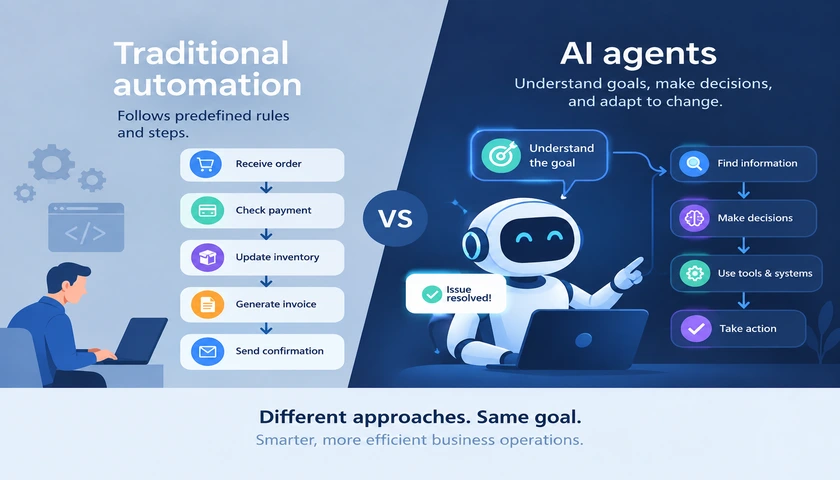
In the rush to be “AI-first,” many enterprises are over-engineering simple problems. They are using a multi-billion parameter Large Language Model (LLM) to perform tasks that a 10-line Python script or a basic IF/THEN statement could handle faster, cheaper, and with 100% accuracy.

At Techmakers, we view AI and Traditional Automation (Deterministic Logic) as two different instruments in the same orchestra. Choosing the wrong one doesn’t just waste budget—it introduces unnecessary “hallucination risk” into your core business processes.

Here is the strategic framework for deciding when to use Probabilistic AI versus Deterministic Automation.


1. Traditional Automation: The “Zero-Error” Zone

Traditional automation is deterministic. If you give it Input A, it will always produce Output B. It follows a strict, pre-defined path of logic.

Choose Traditional Automation when:

  • The Rules are Fixed: Processing a payroll, calculating tax, or syncing inventory levels between a warehouse and an e-commerce store.
  • Accuracy is Non-Negotiable: In financial transactions or medical records, “95% accuracy” is a failure. You need 100%.
  • High Frequency, Low Complexity: Moving data from a form to a database. It’s boring, repetitive, and doesn’t require “thought.”

The Technical Move: Use APIs, Cron Jobs, or RPA (Robotic Process Automation). This is the “backbone” of your digital transformation.

2. AI & Machine Learning: The “Unstructured” Zone

AI is probabilistic. It doesn’t follow a fixed map; it predicts the most likely outcome based on patterns. It thrives where rules are fuzzy or non-existent.

Choose AI when:

  • The Input is Unstructured: Analyzing a 50-page PDF contract, summarizing a recorded Zoom call, or identifying a “happy” customer vs. an “angry” one in support tickets.
  • The Output Requires Creativity: Generating personalized marketing copy, suggesting code snippets, or creating synthetic data for testing.
  • Patterns are Hidden: Predicting which users are likely to churn next month based on subtle changes in their behavior.

The Technical Move: Use LLMs (like Gemini or GPT-4), Computer Vision, or Vector Search.


3. The Hybrid Model: The “Techmakers” Standard

The most powerful enterprise apps don’t choose one; they use Traditional Automation as the guardrails for AI.

Example: Automated Invoice Processing

  1. AI Layer: “Reads” a messy, scanned PDF invoice and extracts the “Total Due” and “Vendor Name” (Unstructured data).
  2. Traditional Layer: Checks the “Vendor Name” against your verified SQL database and ensures the “Total Due” doesn’t exceed a pre-set $500 limit (Deterministic rules).
  3. Outcome: High speed with zero “hallucinated” payments.

Decision Matrix: AI vs. Deterministic Logic

FeatureTraditional AutomationAI Implementation
Logic TypeIf/Then (Rules-Based)Probabilistic (Pattern-Based)
Data TypeStructured (Tables/CSV)Unstructured (Text/Images/Audio)
Cost per TaskNegligible (CPU cycles)Moderate (GPU/Token costs)
Failure ModeStops/Errors out (Safe)Hallucinates (Risky)
ScalabilityHigh (Linear)High (Exponential with RAG)

Summary: Don’t Kill a Fly with a Sledgehammer

AI is a transformative power, but it is an expensive and “fuzzy” way to solve simple logic problems. Before you add an “AI” label to a feature, ask: “Can I write a rule for this?”

If the answer is Yes, automate it traditionally.

If the answer is “It depends on the context,” call in the AI.

At Techmakers, we help you architect a Modular Stack where AI handles the complexity and traditional code handles the consistency. That is how you build an “Elite” score infrastructure.

The question for enterprise leaders in 2026 is no longer if they should adopt AI, but how they can do so without creating a fragmented, unmanaged, and expensive landscape of “AI silos.”

Most organizations start with a “Chatbot-first” mentality. While low-hanging fruit is tempting, true digital transformation happens when AI is woven into the structural fabric of the company. At Techmakers, we’ve identified that successful AI adoption isn’t a software upgrade—it is an architectural and cultural shift.

Here is the four-pillar strategy for moving from AI experimentation to enterprise-grade execution.


1. The Data Liquidity Audit: Fueling the Engine

AI is only as intelligent as the data it can access. Most enterprises struggle because their data is “frozen” in legacy monoliths or disconnected spreadsheets. To succeed, you must move from Data Hoarding to Data Liquidity.

The Technical Move: Implement a Vector Database (like Pinecone or Milvus) alongside your relational data. This allows your AI to perform “semantic search”—understanding the intent behind a query rather than just matching keywords.

2. RAG over Fine-Tuning: Context is King

A common mistake is attempting to “train” a custom LLM on company data. This is expensive, slow to update, and prone to hallucinations.

The Technical Move: Use Retrieval-Augmented Generation (RAG). Instead of teaching the model your data, you give the model a “library card.” When a user asks a question, the system retrieves the most relevant, up-to-date documents from your private cloud and asks the AI to summarize only that information.

  • Benefit: Higher accuracy, lower costs, and immediate data updates without retraining.

3. The “AI Guardrails” Framework: Security & Compliance

In a regulated enterprise environment, “unfiltered” AI is a liability. You need a middle layer—an AI Gateway—that sits between your users and the Large Language Models.

The Strategy:

  • PII Redaction: Automatically scrubbing personally identifiable information before it hits a public API.
  • Cost Management: Implementing “Token Quotas” to prevent a single department from blowing the monthly API budget on experimental prompts.
  • Hallucination Checks: Using secondary “validator” models to cross-reference AI outputs against your ground-truth data.

4. Concurrent Engineering: Building the Interface

AI is useless if the user interface is clunky. Successful adoption requires Designers who Code. The UI for an AI-powered app isn’t a static dashboard; it’s a conversational, generative, and adaptive experience.

The Techmakers Edge: We use Design Tokens to ensure that as your AI features evolve, the UI scales with them. By syncing design and engineering in real-time, we can roll out “AI-First” features in weeks, ensuring your team actually uses the tools you build.


The Maturity Curve: Where Does Your Enterprise Stand?

StageCharacteristicsThe Next Step
ExperimentalUsing public ChatGPT for basic tasks.Conduct a Data Security Audit.
OperationalInternal RAG-based tools for HR/Wiki.Integrate AI into core product workflows.
OptimizedAI-driven decision making and automation.Scale via Modular Microservices.

Conclusion: The Partner Advantage

Adopting AI is a high-stakes move. If you build on a fractured foundation, you are simply automating your existing inefficiencies.

At Techmakers, we help enterprises bypass the “Hype Phase” and move directly into Value Creation. We don’t just give you an AI tool; we give you a scalable, secure, and data-liquid ecosystem that becomes a permanent competitive advantage.