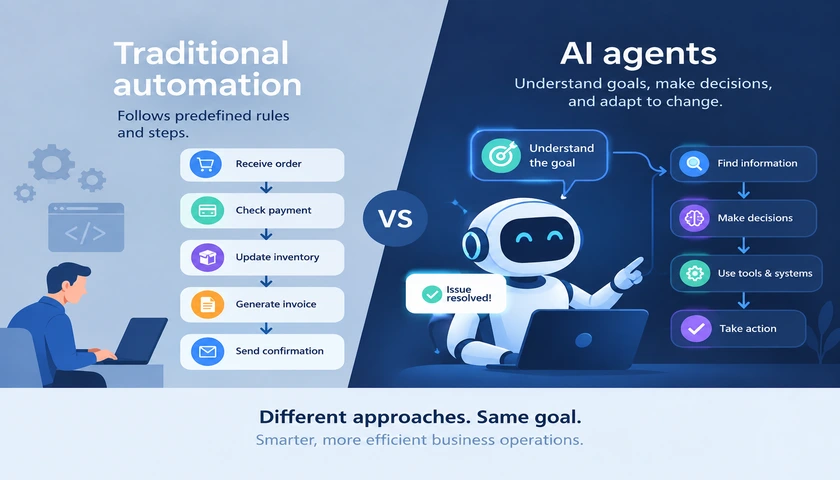
In the rush to be “AI-first,” many enterprises are over-engineering simple problems. They are using a multi-billion parameter Large Language Model (LLM) to perform tasks that a 10-line Python script or a basic IF/THEN statement could handle faster, cheaper, and with 100% accuracy.
At Techmakers, we view AI and Traditional Automation (Deterministic Logic) as two different instruments in the same orchestra. Choosing the wrong one doesn’t just waste budget—it introduces unnecessary “hallucination risk” into your core business processes.
Here is the strategic framework for deciding when to use Probabilistic AI versus Deterministic Automation.
1. Traditional Automation: The “Zero-Error” Zone
Traditional automation is deterministic. If you give it Input A, it will always produce Output B. It follows a strict, pre-defined path of logic.
Choose Traditional Automation when:
- The Rules are Fixed: Processing a payroll, calculating tax, or syncing inventory levels between a warehouse and an e-commerce store.
- Accuracy is Non-Negotiable: In financial transactions or medical records, “95% accuracy” is a failure. You need 100%.
- High Frequency, Low Complexity: Moving data from a form to a database. It’s boring, repetitive, and doesn’t require “thought.”
The Technical Move: Use APIs, Cron Jobs, or RPA (Robotic Process Automation). This is the “backbone” of your digital transformation.
2. AI & Machine Learning: The “Unstructured” Zone
AI is probabilistic. It doesn’t follow a fixed map; it predicts the most likely outcome based on patterns. It thrives where rules are fuzzy or non-existent.
Choose AI when:
- The Input is Unstructured: Analyzing a 50-page PDF contract, summarizing a recorded Zoom call, or identifying a “happy” customer vs. an “angry” one in support tickets.
- The Output Requires Creativity: Generating personalized marketing copy, suggesting code snippets, or creating synthetic data for testing.
- Patterns are Hidden: Predicting which users are likely to churn next month based on subtle changes in their behavior.
The Technical Move: Use LLMs (like Gemini or GPT-4), Computer Vision, or Vector Search.
3. The Hybrid Model: The “Techmakers” Standard
The most powerful enterprise apps don’t choose one; they use Traditional Automation as the guardrails for AI.
Example: Automated Invoice Processing
- AI Layer: “Reads” a messy, scanned PDF invoice and extracts the “Total Due” and “Vendor Name” (Unstructured data).
- Traditional Layer: Checks the “Vendor Name” against your verified SQL database and ensures the “Total Due” doesn’t exceed a pre-set $500 limit (Deterministic rules).
- Outcome: High speed with zero “hallucinated” payments.
Decision Matrix: AI vs. Deterministic Logic
| Feature | Traditional Automation | AI Implementation |
| Logic Type | If/Then (Rules-Based) | Probabilistic (Pattern-Based) |
| Data Type | Structured (Tables/CSV) | Unstructured (Text/Images/Audio) |
| Cost per Task | Negligible (CPU cycles) | Moderate (GPU/Token costs) |
| Failure Mode | Stops/Errors out (Safe) | Hallucinates (Risky) |
| Scalability | High (Linear) | High (Exponential with RAG) |
Summary: Don’t Kill a Fly with a Sledgehammer
AI is a transformative power, but it is an expensive and “fuzzy” way to solve simple logic problems. Before you add an “AI” label to a feature, ask: “Can I write a rule for this?”
If the answer is Yes, automate it traditionally.
If the answer is “It depends on the context,” call in the AI.
At Techmakers, we help you architect a Modular Stack where AI handles the complexity and traditional code handles the consistency. That is how you build an “Elite” score infrastructure.