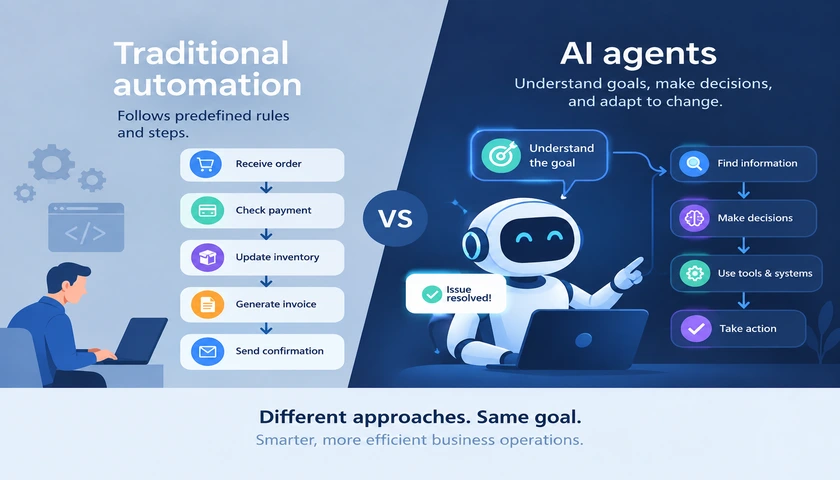
Artificial Intelligence (AI) is rapidly changing how modern applications are built and used. From mobile apps and web platforms to enterprise software and automation tools, businesses are increasingly integrating AI to improve user experiences, automate processes, and make smarter business decisions.
Today’s users expect applications to be faster, more personalized, and capable of understanding their needs in real time. Traditional applications often struggle to meet these expectations without intelligent automation and data-driven capabilities.
This is why AI integration is becoming an essential part of modern application development across industries.
What Does AI Integration Mean in Applications?
AI integration refers to adding intelligent features and machine learning capabilities into applications to automate tasks, analyze data, and improve decision-making.
AI-powered applications can:
- Understand user behavior
- Automate repetitive tasks
- Provide personalized recommendations
- Predict future trends
- Improve customer interactions
- Process large amounts of data quickly
Modern businesses use AI to create smarter, faster, and more scalable digital experiences.
Why Businesses Are Adopting AI in Applications
Businesses are integrating AI into applications to improve operational efficiency, customer engagement, and business performance.
AI helps organizations:
- Reduce manual work
- Improve response times
- Enhance customer experiences
- Increase productivity
- Support data-driven decisions
- Scale digital operations more efficiently
As competition increases across industries, businesses are using AI to deliver more intelligent and personalized services.
1. Personalized User Experiences
One of the biggest advantages of AI integration is personalization.
AI systems analyze user behavior, preferences, search history, and interactions to deliver customized experiences in real time.
Examples include:
- Product recommendations in eCommerce apps
- Personalized content feeds
- AI-powered chat assistants
- Customized dashboards
- Smart notifications and suggestions
Personalization helps improve user engagement, customer satisfaction, and retention rates.
2. Predictive Analytics and Smarter Decision-Making
AI-powered applications can analyze large volumes of data and identify patterns that help businesses make better decisions.
Predictive analytics helps organizations:
- Forecast customer behavior
- Predict sales trends
- Detect fraud or anomalies
- Optimize inventory management
- Improve operational planning
Instead of relying only on historical reports, businesses can use AI to make proactive and data-driven decisions.
3. Automation of Repetitive Tasks
AI integration helps automate time-consuming and repetitive processes that normally require manual effort.
This may include:
- Customer support automation
- Data entry and processing
- Workflow management
- Document analysis
- Scheduling and notifications
Automation improves efficiency, reduces operational costs, and allows teams to focus on higher-value tasks.
4. Improved Customer Support with AI Chatbots
Many businesses now use AI-powered chatbots and virtual assistants to improve customer support experiences.
AI chatbots can:
- Answer common customer questions
- Provide instant support
- Handle multiple conversations simultaneously
- Offer 24/7 assistance
- Reduce support workload
Modern AI chatbots also improve over time using machine learning and user interactions.
5. Better Data Processing and Insights
Modern applications generate large amounts of business and customer data every day.
AI systems can process and analyze this data much faster than traditional methods, helping businesses identify:
- Customer trends
- Operational bottlenecks
- Performance insights
- Marketing opportunities
- Risk factors
This helps organizations improve efficiency and make faster strategic decisions.
6. Scalability for Growing Businesses
As businesses grow, applications must handle increasing amounts of users, transactions, and data.
AI-powered systems built on scalable cloud architectures can adapt more efficiently to growing business requirements.
AI also helps optimize system performance by automating resource allocation, monitoring usage patterns, and improving operational workflows.
7. Enhanced Security and Fraud Detection
AI is also becoming important for cybersecurity and fraud prevention.
AI systems can monitor activity patterns in real time and identify unusual behavior that may indicate:
- Fraudulent transactions
- Unauthorized access
- Security threats
- Data breaches
This helps businesses strengthen security and respond to threats more quickly.
8. Competitive Advantage in Digital Transformation
Businesses that integrate AI into applications can often innovate faster and deliver better digital experiences compared to competitors using traditional systems.
AI integration supports:
- Faster service delivery
- Intelligent automation
- Better customer engagement
- Improved operational efficiency
- Continuous business innovation
As digital transformation continues to grow, AI is becoming a key factor in maintaining long-term competitiveness.
Building Future-Ready Applications with AI
AI integration is no longer limited to large technology companies. Businesses across industries are now adopting AI-powered features to improve efficiency, customer experiences, and business scalability.
From personalization and automation to predictive analytics and intelligent decision-making, AI helps modern applications become smarter and more adaptable to changing business needs.
With the right development strategy, businesses can build secure, scalable, and future-ready applications that support long-term growth and digital innovation.
FAQs
What is AI integration in applications?
AI integration involves adding artificial intelligence features such as automation, machine learning, chatbots, and predictive analytics into mobile, web, or enterprise applications.
Why are businesses integrating AI into modern applications?
Businesses use AI to improve personalization, automate tasks, analyze data, enhance customer experiences, and increase operational efficiency.
Can AI improve customer engagement in apps?
Yes, AI helps deliver personalized experiences, smart recommendations, and faster customer support, which improves user engagement and satisfaction.
What industries benefit from AI-powered applications?
Industries such as healthcare, finance, retail, education, logistics, and manufacturing commonly use AI-powered applications to improve operations and customer experiences.
Is AI integration suitable for small and medium businesses?
Yes, modern cloud-based AI solutions make AI integration more accessible and scalable for businesses of all sizes.