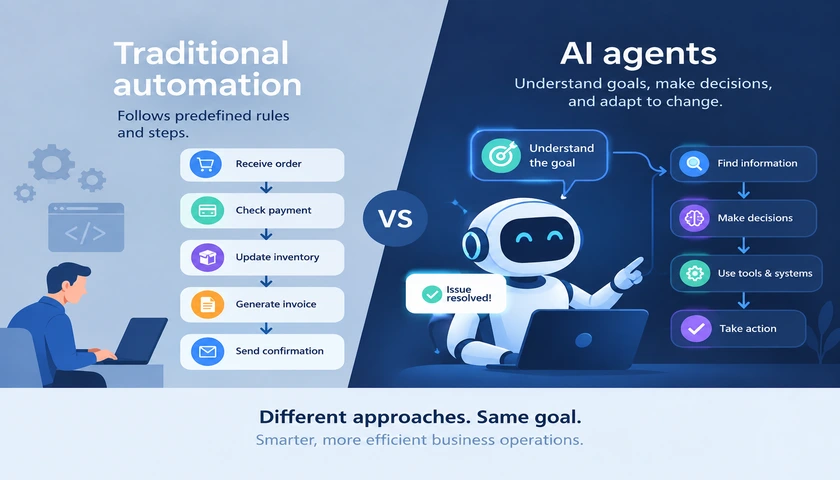
The question for enterprise leaders in 2026 is no longer if they should adopt AI, but how they can do so without creating a fragmented, unmanaged, and expensive landscape of “AI silos.”
Most organizations start with a “Chatbot-first” mentality. While low-hanging fruit is tempting, true digital transformation happens when AI is woven into the structural fabric of the company. At Techmakers, we’ve identified that successful AI adoption isn’t a software upgrade—it is an architectural and cultural shift.
Here is the four-pillar strategy for moving from AI experimentation to enterprise-grade execution.
1. The Data Liquidity Audit: Fueling the Engine
AI is only as intelligent as the data it can access. Most enterprises struggle because their data is “frozen” in legacy monoliths or disconnected spreadsheets. To succeed, you must move from Data Hoarding to Data Liquidity.
The Technical Move: Implement a Vector Database (like Pinecone or Milvus) alongside your relational data. This allows your AI to perform “semantic search”—understanding the intent behind a query rather than just matching keywords.
2. RAG over Fine-Tuning: Context is King
A common mistake is attempting to “train” a custom LLM on company data. This is expensive, slow to update, and prone to hallucinations.
The Technical Move: Use Retrieval-Augmented Generation (RAG). Instead of teaching the model your data, you give the model a “library card.” When a user asks a question, the system retrieves the most relevant, up-to-date documents from your private cloud and asks the AI to summarize only that information.
- Benefit: Higher accuracy, lower costs, and immediate data updates without retraining.
3. The “AI Guardrails” Framework: Security & Compliance
In a regulated enterprise environment, “unfiltered” AI is a liability. You need a middle layer—an AI Gateway—that sits between your users and the Large Language Models.
The Strategy:
- PII Redaction: Automatically scrubbing personally identifiable information before it hits a public API.
- Cost Management: Implementing “Token Quotas” to prevent a single department from blowing the monthly API budget on experimental prompts.
- Hallucination Checks: Using secondary “validator” models to cross-reference AI outputs against your ground-truth data.
4. Concurrent Engineering: Building the Interface
AI is useless if the user interface is clunky. Successful adoption requires Designers who Code. The UI for an AI-powered app isn’t a static dashboard; it’s a conversational, generative, and adaptive experience.
The Techmakers Edge: We use Design Tokens to ensure that as your AI features evolve, the UI scales with them. By syncing design and engineering in real-time, we can roll out “AI-First” features in weeks, ensuring your team actually uses the tools you build.
The Maturity Curve: Where Does Your Enterprise Stand?
| Stage | Characteristics | The Next Step |
| Experimental | Using public ChatGPT for basic tasks. | Conduct a Data Security Audit. |
| Operational | Internal RAG-based tools for HR/Wiki. | Integrate AI into core product workflows. |
| Optimized | AI-driven decision making and automation. | Scale via Modular Microservices. |
Conclusion: The Partner Advantage
Adopting AI is a high-stakes move. If you build on a fractured foundation, you are simply automating your existing inefficiencies.
At Techmakers, we help enterprises bypass the “Hype Phase” and move directly into Value Creation. We don’t just give you an AI tool; we give you a scalable, secure, and data-liquid ecosystem that becomes a permanent competitive advantage.