Enterprise software has evolved significantly over the years. What began as systems primarily used for storing and managing business data has transformed into intelligent platforms that support decision-making, automate operations, and improve productivity.
One of the biggest drivers behind this transformation is the rise of AI agents.
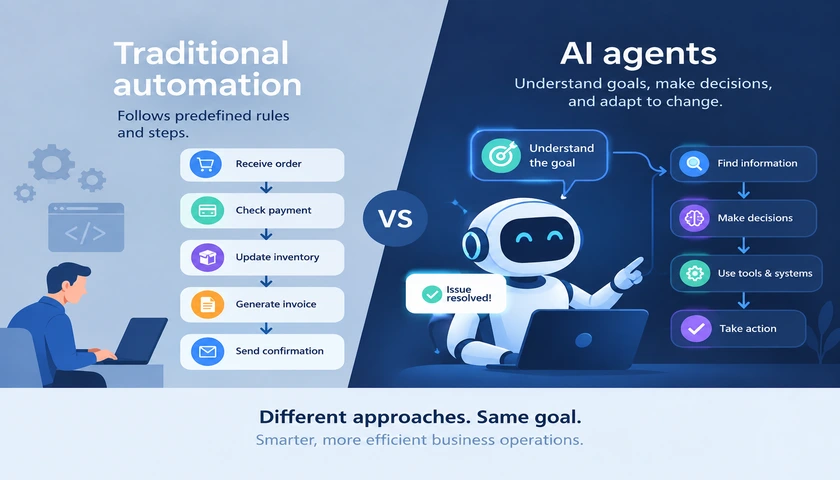
Unlike traditional automation tools that follow predefined rules, AI agents can analyze information, learn from interactions, make recommendations, and perform tasks with minimal human intervention.
As businesses continue investing in digital transformation, AI agents are becoming an increasingly important component of modern enterprise software.
What are AI agents?
AI agents are intelligent software systems designed to perform tasks, process information, and interact with users or other systems autonomously.
They can leverage technologies such as:
- Artificial Intelligence
- Machine Learning
- Natural Language Processing
- Predictive Analytics
- Automation
Unlike basic chatbots or workflow automation tools, AI agents can often understand context, adapt to changing conditions, and support more complex business processes.
This makes them valuable across a wide range of enterprise applications.
Why enterprises are adopting AI agents
Businesses are constantly looking for ways to improve efficiency, reduce costs, and enhance decision-making.
AI agents help achieve these goals by:
- Automating repetitive tasks
- Improving response times
- Supporting data-driven decisions
- Enhancing customer experiences
- Reducing operational complexity
As AI technology becomes more accessible, organizations are finding new opportunities to integrate intelligent agents into their existing software ecosystems.
Transforming business process automation
Automation has been a major focus for enterprises for many years.
Traditional automation solutions often require predefined workflows and rules.
AI agents take automation a step further by introducing intelligence into the process.
Examples include:
- Automatically processing requests
- Routing tasks to appropriate teams
- Generating reports
- Managing approvals
- Identifying operational bottlenecks
This allows businesses to automate more complex workflows while improving accuracy and efficiency.
Improving employee productivity
Enterprise software is used daily by employees across departments.
AI agents can help teams work more efficiently by handling routine tasks and providing relevant information when needed.
Examples include:
- Scheduling meetings
- Summarizing documents
- Retrieving business data
- Answering internal questions
- Managing repetitive administrative tasks
By reducing manual workloads, employees can focus on strategic and higher-value activities.
Enhancing customer support experiences
Customer service is one of the most common areas where AI agents are creating value.
Modern AI-powered agents can:
- Answer customer questions
- Resolve common issues
- Route support requests
- Provide personalized recommendations
- Operate around the clock
This helps businesses improve response times while maintaining consistent service quality.
Customers benefit from faster support, while organizations reduce pressure on customer service teams.
Supporting smarter decision-making
Enterprise software generates large amounts of data every day.
AI agents can analyze this information and help businesses identify patterns, trends, and opportunities.
Common use cases include:
- Sales forecasting
- Demand prediction
- Risk assessment
- Performance monitoring
- Business intelligence reporting
Rather than manually reviewing large datasets, decision-makers can receive actionable insights more quickly.
Strengthening enterprise knowledge management
Many organizations struggle with information scattered across multiple systems and departments.
AI agents can help employees access relevant information faster by searching across connected platforms and presenting useful insights in a simple format.
Benefits include:
- Faster information retrieval
- Reduced knowledge silos
- Improved collaboration
- Better onboarding experiences
This can significantly improve efficiency across large organizations.
Creating more personalized user experiences
Enterprise software is increasingly expected to deliver personalized experiences similar to consumer applications.
AI agents can adapt interfaces, recommendations, and workflows based on user behavior and preferences.
Examples include:
- Personalized dashboards
- Intelligent recommendations
- Customized reporting
- Context-aware assistance
These capabilities improve usability and help users accomplish tasks more efficiently.
Integrating AI agents into existing enterprise systems
Many businesses assume AI adoption requires replacing existing software.
In reality, AI agents are often integrated into current enterprise platforms through APIs, cloud services, and custom development solutions.
They can work alongside systems such as:
- CRM platforms
- ERP software
- Customer support systems
- HR platforms
- Financial applications
This allows organizations to enhance existing technology investments rather than starting from scratch.
Security and governance considerations
As AI agents gain access to business data and critical processes, security becomes increasingly important.
Organizations should focus on:
- Access controls
- Data protection
- User authentication
- Monitoring and auditing
- Compliance requirements
- AI governance policies
Responsible implementation helps ensure AI agents operate securely while maintaining business trust and regulatory compliance.
Challenges businesses should prepare for
While AI agents offer significant benefits, successful implementation requires careful planning.
Common challenges include:
- Data quality issues
- Integration complexity
- User adoption concerns
- Security requirements
- Governance and compliance considerations
- Ongoing monitoring and optimization
Businesses that address these challenges early are more likely to achieve successful outcomes.
The future of enterprise software is becoming more intelligent
AI agents represent a major shift in how enterprise software operates.
Rather than simply serving as tools for storing and managing information, modern platforms are becoming active participants in business operations.
As AI technologies continue to advance, enterprise software will become increasingly capable of automating tasks, providing insights, supporting decision-making, and enhancing user experiences.
Organizations that embrace AI agents strategically can improve efficiency, strengthen competitiveness, and unlock new opportunities for innovation.
Moving from software systems to intelligent business platforms
The role of enterprise software is evolving rapidly.
Businesses are no longer looking for systems that simply manage data. They want intelligent platforms that help teams work smarter, respond faster, and make better decisions.
AI agents are making this possible by bringing automation, intelligence, and adaptability directly into everyday business applications.
As adoption continues to grow, AI agents are expected to become a standard feature of modern enterprise software, helping organizations build more efficient, scalable, and future-ready digital operations.
FAQs
How are AI agents different from traditional automation tools?
Traditional automation follows predefined rules, while AI agents can analyze information, understand context, adapt to changing situations, and make intelligent recommendations.
Can AI agents work with existing enterprise software?
Yes. Many AI agents can be integrated into CRM systems, ERP platforms, customer service applications, and other enterprise tools without replacing existing software.
Which business departments benefit most from AI agents?
Customer service, sales, marketing, human resources, operations, finance, and IT teams can all benefit from AI-powered automation and intelligent assistance.
Are AI agents only useful for large enterprises?
No. Businesses of all sizes can use AI agents to automate processes, improve productivity, and enhance customer experiences.
What should businesses consider before implementing AI agents?
Organizations should evaluate their business goals, data quality, integration requirements, security policies, and user adoption strategies before deploying AI agents.