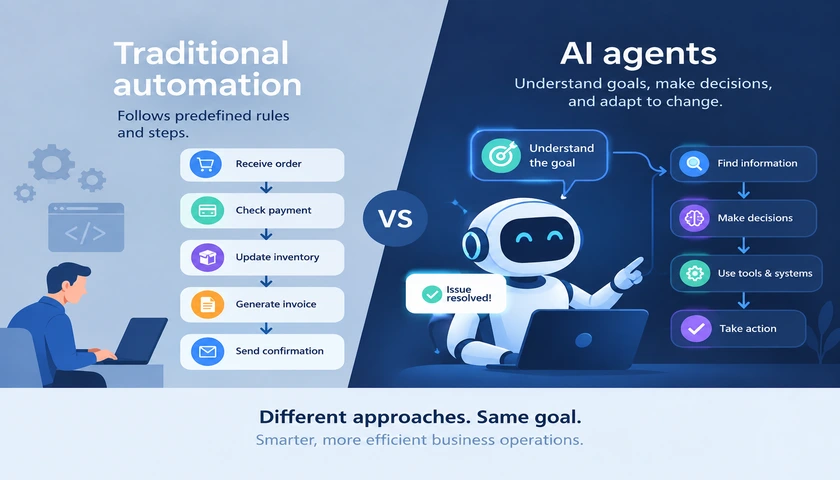
Artificial Intelligence (AI) is no longer limited to research labs or large technology companies. Today, businesses of all sizes are using AI to improve efficiency, automate repetitive tasks, enhance customer experiences, and make better business decisions.
As AI technologies become more accessible, organizations across different industries are finding practical ways to integrate intelligent solutions into their daily operations.
Rather than replacing people, AI is helping teams work smarter by providing faster insights, reducing manual effort, and improving the accuracy of business processes.
Let’s explore some of the most practical AI use cases across different industries.
Why businesses are investing in AI
Businesses are adopting AI because it delivers measurable improvements across multiple areas.
Common benefits include:
- Automating repetitive tasks
- Improving operational efficiency
- Faster decision-making
- Better customer experiences
- More accurate forecasting
- Reduced operational costs
- Increased productivity
These advantages make AI an important part of modern digital transformation strategies.
Healthcare
Healthcare organizations are using AI to improve both patient care and operational efficiency.
Common applications include:
- Patient appointment scheduling
- Medical image analysis
- Clinical decision support
- Virtual health assistants
- Predictive patient monitoring
- Hospital resource planning
AI helps healthcare providers make faster decisions while improving the overall patient experience.
Financial services
Banks, insurance providers, and financial institutions generate enormous amounts of data every day.
AI helps process this information more efficiently by supporting:
- Fraud detection
- Risk assessment
- Credit analysis
- Customer support automation
- Investment insights
- Document processing
These solutions improve accuracy while reducing manual review efforts.
Retail and eCommerce
Retail businesses are using AI to deliver more personalized shopping experiences.
Popular use cases include:
- Product recommendations
- Inventory forecasting
- Dynamic pricing
- Customer behavior analysis
- Automated customer support
- Demand prediction
AI enables retailers to better understand customer preferences and optimize business operations.
Manufacturing
Manufacturers are adopting AI to improve productivity and reduce downtime.
Examples include:
- Predictive equipment maintenance
- Production quality monitoring
- Supply chain optimization
- Demand forecasting
- Process automation
- Production scheduling
These applications help improve operational efficiency while reducing costs.
Logistics and supply chain
AI is helping logistics companies manage increasingly complex supply chains.
Common applications include:
- Route optimization
- Fleet management
- Delivery scheduling
- Warehouse automation
- Shipment tracking
- Inventory planning
Better planning and automation improve delivery performance and resource utilization.
Customer service
Customer support remains one of the most popular areas for AI adoption.
Businesses use AI to:
- Answer frequently asked questions
- Route support requests
- Provide 24/7 customer assistance
- Analyze customer sentiment
- Recommend solutions
- Improve response times
This allows support teams to focus on more complex customer issues while maintaining consistent service quality.
Human resources
HR departments are using AI to simplify recruitment and employee management.
Examples include:
- Resume screening
- Candidate matching
- Employee onboarding
- Performance analysis
- Learning recommendations
- Workforce planning
AI helps HR teams make more informed decisions while reducing administrative work.
Education
Educational institutions and online learning platforms are using AI to create more personalized learning experiences.
Applications include:
- Personalized learning paths
- Automated assessments
- Student performance analysis
- Virtual learning assistants
- Course recommendations
- Administrative automation
AI supports both educators and learners by making education more accessible and efficient.
Real estate
Real estate businesses are increasingly using AI to improve customer engagement and property management.
Common use cases include:
- Property recommendations
- Market trend analysis
- Customer inquiry automation
- Price estimation
- Document management
- Lead qualification
These capabilities help real estate professionals respond more quickly and make better-informed decisions.
Enterprise software
AI is transforming enterprise applications by making them more intelligent and efficient.
Businesses are integrating AI into enterprise software for:
- Workflow automation
- Intelligent reporting
- Business process optimization
- Data analysis
- Knowledge management
- Decision support
Modern enterprise platforms are evolving from simple management systems into intelligent business assistants.
What businesses should consider before implementing AI
While AI offers significant opportunities, successful adoption requires careful planning.
Businesses should evaluate:
- Business objectives
- Data quality
- Security requirements
- Integration needs
- Employee adoption
- Long-term scalability
AI delivers the best results when implemented to solve real business challenges rather than simply following industry trends.
The future of AI across industries
AI adoption continues to accelerate across nearly every sector.
As technologies become more advanced, businesses can expect AI to play a greater role in:
- Intelligent automation
- Predictive analytics
- Personalized customer experiences
- Operational optimization
- Decision support
- Business innovation
Organizations that invest in AI strategically today will be better prepared to compete in tomorrow’s digital economy.
Turning AI into business value
Artificial Intelligence is no longer a future technology—it is already transforming the way businesses operate.
From healthcare and finance to manufacturing, retail, logistics, and enterprise software, AI is helping organizations improve efficiency, reduce costs, enhance customer experiences, and make smarter decisions.
The most successful AI projects are those that focus on solving practical business problems with measurable outcomes.
As AI capabilities continue to evolve, businesses that embrace intelligent technologies responsibly will be well-positioned to drive innovation, improve competitiveness, and build a strong foundation for long-term growth.
FAQs
Which industries benefit the most from AI?
Industries such as healthcare, finance, retail, manufacturing, logistics, education, and enterprise software are among the biggest adopters of AI, but organizations in almost every sector can benefit from AI-driven solutions.
Do businesses need large amounts of data to implement AI?
While high-quality data improves AI performance, many AI solutions can deliver value using existing business data when properly organized and managed.
Can small businesses benefit from AI?
Yes. AI-powered tools for customer support, marketing, analytics, and automation are becoming more affordable, making them accessible for small and medium-sized businesses.
How can businesses identify the right AI use case?
The best approach is to start by identifying repetitive tasks, operational bottlenecks, or areas where faster insights and automation can improve business performance.
What is the biggest challenge when implementing AI?
Common challenges include poor data quality, integration with existing systems, employee adoption, security concerns, and selecting AI solutions that align with business goals.