Artificial intelligence is transforming how businesses communicate with customers, manage information, and automate everyday operations. Among the most widely discussed AI technologies are AI chatbots and AI agents.
Although these technologies may appear similar, they serve different purposes. AI chatbots primarily focus on conversations and answering questions, while AI agents can take actions, interact with software systems, and complete tasks with varying levels of autonomy.
Understanding the differences between AI agents and AI chatbots is essential for organizations planning to invest in artificial intelligence.
This guide explores how both technologies work, their capabilities, benefits, limitations, costs, and real-world business applications to help you choose the right solution.
What is an AI chatbot?
An AI chatbot is a software application designed to communicate with users through text or voice.
Traditional chatbots typically follow predefined rules, decision trees, or scripted conversations. Modern AI chatbots use natural language processing (NLP) and large language models (LLMs) to understand questions and generate more flexible responses.
Businesses commonly use AI chatbots to answer customer enquiries, provide product information, assist with website navigation, and support employees.
For example, an online shopping website might use an AI chatbot to answer questions about product availability, shipping policies, or return procedures.
AI chatbots are particularly useful for businesses that need to manage large volumes of repetitive conversations.
Key features of AI chatbots
- Natural language conversations
- Automated customer support
- Frequently asked question handling
- Product and service information
- Multilingual communication
- Integration with websites and messaging platforms
- Knowledge base search and information retrieval
Advanced chatbots can also connect with business applications and perform specific actions. Therefore, the distinction between chatbots and agents depends on their capabilities rather than the interface alone.
What is an AI agent?
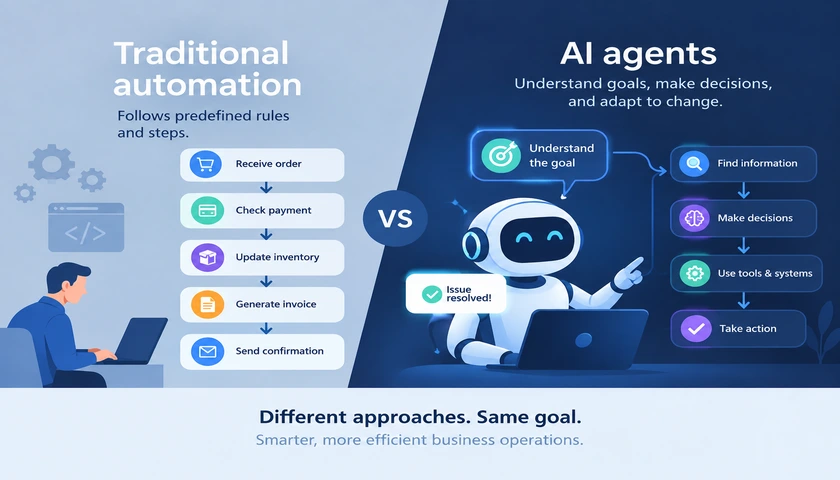
An AI agent is an AI-powered system designed to pursue specific goals, make decisions within defined boundaries, and perform actions using connected tools or applications.
Unlike a chatbot that mainly provides conversational responses, an AI agent can coordinate multiple steps to complete a task.
AI agents may interact with databases, APIs, business software, and external tools to retrieve information, process requests, and execute approved workflows.
For example, a sales AI agent could retrieve customer information from a CRM, identify pending follow-ups, draft personalized messages, and create tasks for the sales team.
Depending on its permissions and configuration, the agent may perform some actions automatically while requiring human approval for others.
Key features of AI agents
- Goal-oriented task execution
- Multi-step workflow automation
- Decision-making within defined rules
- Integration with APIs and business applications
- Context-aware task planning
- Information retrieval and analysis
- Tool usage and action execution
- Human approval for sensitive operations
AI agents are especially useful when businesses need to automate processes involving multiple systems or decisions.
AI agents vs. AI chatbots: Key differences
The main difference between AI agents and AI chatbots is how they interact with users and complete tasks.
AI chatbots are generally conversation-focused, while AI agents are designed to pursue goals and perform actions.
However, modern AI systems increasingly combine both capabilities.
The following table highlights the major differences.
| Feature | AI chatbots | AI agents |
|---|---|---|
| Primary purpose | Answer questions and assist users | Complete tasks and achieve goals |
| Interaction | Primarily conversational | Conversational or task-driven |
| Autonomy | Usually limited or predefined | Can operate with greater autonomy |
| Task complexity | Simple to moderately complex | Often supports multi-step tasks |
| Decision-making | Based on instructions and context | Can plan and select actions |
| Tool integration | Optional, depending on design | Commonly central to operation |
| Workflow automation | Usually predefined actions | Can coordinate multiple actions |
| Human involvement | Often user-initiated | Depends on autonomy and risk |
| Implementation complexity | Generally lower | Often higher |
| Typical use cases | FAQs, customer support, assistance | Process automation, research, operations |
The key takeaway: AI chatbots primarily help users through conversations, while AI agents can use information and connected tools to complete broader business tasks.
How do AI chatbots work?
AI chatbots receive user input, interpret the request, and generate an appropriate response.
The underlying process depends on whether the chatbot is rule-based or AI-powered.
1. User submits a question
A customer or employee enters a message through a website, mobile application, or messaging platform.
2. The chatbot processes the request
A rule-based chatbot identifies matching keywords or predefined conversation paths.
An AI-powered chatbot uses a language model to interpret the request and its context.
3. Relevant information is retrieved
The chatbot may access a knowledge base, product catalog, or connected business system to find relevant information.
4. A response is generated
The chatbot provides an answer, asks a follow-up question, or directs the user to another resource.
5. The conversation continues
The chatbot uses available conversation context to respond to subsequent questions.
This process makes AI chatbots useful for customer-facing interactions and internal assistance.
How do AI agents work?
AI agents typically use a more action-oriented process.
Instead of only generating responses, they can evaluate a goal, determine the steps required, and interact with connected systems.
Step 1: Receive a goal or task
A user or authorized system provides an objective.
For example, a sales manager might request a summary of leads that have not received follow-up communication.
Step 2: Analyze the requirements
The AI agent interprets the task and identifies the information, tools, and actions required.
Step 3: Plan the workflow
The agent determines an appropriate sequence of steps.
For example, it may need to retrieve CRM records, filter leads, analyze previous interactions, and prepare a report.
Step 4: Execute approved actions
The agent interacts with connected applications through APIs or other authorized tools.
Depending on its permissions, it may retrieve data, create records, draft messages, or trigger workflows.
Step 5: Evaluate the results
The agent checks available outputs and may adjust its next steps if the task is incomplete.
Step 6: Deliver the outcome
The agent provides the completed result or requests human approval before performing sensitive actions.
This ability to coordinate multiple activities makes AI agents suitable for complex business automation.
Business use cases of AI chatbots
AI chatbots can improve customer experiences and simplify information access across different industries.
Customer support automation
Businesses can deploy chatbots to answer frequently asked questions, explain policies, and assist customers with common problems.
Complex enquiries can be escalated to human representatives when necessary.
E-commerce assistance
AI chatbots can help customers discover products, compare options, and understand shipping or return policies.
When connected to approved systems, they may also provide order-related information.
Employee assistance
Internal chatbots can answer questions about company policies, onboarding procedures, and technical documentation.
Lead generation
Website chatbots can collect customer requirements, answer initial questions, and pass qualified enquiries to sales teams.
Appointment assistance
Chatbots can help users explore appointment options and, when integrated with scheduling software, support booking workflows.
Business use cases of AI agents
AI agents can support more complex operations that involve multiple steps and connected applications.
Sales and CRM automation
AI agents can analyze customer records, identify follow-up opportunities, prepare personalized communications, and create CRM tasks.
Financial reporting
An AI agent can retrieve authorized financial data, organize information, and prepare draft reports for review.
Financial outputs should be validated before being used for important decisions.
IT support and operations
AI agents can assist with troubleshooting, classify support tickets, retrieve technical documentation, and execute approved maintenance workflows.
Human resources automation
Organizations can use AI agents to coordinate onboarding tasks, organize employee documentation, and assist with routine HR processes.
Business intelligence
AI agents can retrieve information from connected data sources, generate summaries, and help teams investigate operational performance.
Workflow coordination
An agent can coordinate activities across CRM, ERP, project management, and communication platforms.
These capabilities can reduce manual effort in processes that would otherwise require employees to switch between multiple applications.
Benefits of AI chatbots for businesses
AI chatbots provide several advantages for organizations focused on customer communication and employee support.
Faster customer responses
Chatbots can respond immediately to common enquiries, reducing waiting times.
24/7 availability
Automated assistants can provide basic support outside normal business hours.
Reduced support workload
Handling repetitive questions allows customer service teams to focus on complex issues.
Consistent information delivery
When connected to reliable information sources, chatbots can provide more consistent answers to common questions.
Scalable customer engagement
Businesses can handle larger conversation volumes without increasing staffing at the same rate.
Benefits of AI agents for businesses
AI agents offer additional capabilities for organizations seeking broader automation.
Multi-step process automation
Agents can coordinate tasks involving several applications and information sources.
Improved operational efficiency
Automating repetitive activities can reduce manual work and shorten processing times.
Faster task completion
Agents can retrieve information, process requests, and execute approved actions within connected systems.
Better information accessibility
Employees can interact with multiple business systems through a unified AI-powered workflow.
Flexible automation
AI agents can adapt task sequences based on available information and predefined operational boundaries.
These benefits depend on integration quality, reliable data, effective monitoring, and appropriate security controls.
AI agents vs. AI chatbots: Which is better for your business?
Neither technology is universally better. The right choice depends on the problem your organization wants to solve.
Choose an AI chatbot when:
- Your primary goal is answering customer questions.
- You need conversational assistance on a website or application.
- Most interactions involve retrieving and presenting information.
- You want to automate common support enquiries.
- Your workflows are relatively straightforward.
Choose an AI agent when:
- You need to automate multi-step business processes.
- Tasks require interaction with several applications.
- Your system must plan and execute actions.
- You want to coordinate complex internal workflows.
- You can establish suitable permissions, monitoring, and approval controls.
Can businesses use both AI chatbots and AI agents?
Yes. Many organizations can benefit from combining conversational interfaces with agent-based automation.
For example, a customer may ask a chatbot to reschedule an appointment.
The chatbot can collect the required details, while an AI agent or connected workflow checks availability, updates the scheduling system, and confirms the result.
This approach combines natural language communication with task execution.
AI agents vs. AI chatbots: Cost comparison
Development costs depend on the complexity, integrations, and operational requirements of each solution.
AI chatbots are often less expensive to implement when they primarily answer questions using predefined information.
AI agents may require additional investment because they can involve workflow orchestration, multiple API connections, access controls, and ongoing evaluation.
| Cost factor | AI chatbots | AI agents |
|---|---|---|
| Initial development | Often lower | Often higher |
| System integration | Limited to moderate | Moderate to extensive |
| AI model usage | Depends on conversation volume | Depends on tasks, tools, and execution steps |
| Testing requirements | Conversation accuracy and reliability | Task execution, accuracy, and safety |
| Security requirements | Data access and conversation protection | Data access, tool permissions, and action controls |
| Maintenance | Knowledge updates and performance monitoring | Workflow monitoring, integration maintenance, and evaluation |
Actual expenses vary significantly depending on implementation scope.
Businesses should evaluate total ownership costs, including development, infrastructure, model usage, monitoring, and maintenance.
Challenges of implementing AI chatbots and AI agents
Both technologies require careful planning to deliver reliable business outcomes.
Accuracy and reliability
AI-generated responses can be incorrect or incomplete.
Businesses should use reliable information sources, evaluate outputs, and implement appropriate validation.
Data security and privacy
Connecting AI systems with business information introduces data protection responsibilities.
Applications should enforce authentication, authorization, and appropriate data handling policies.
Integration complexity
Existing applications may require custom APIs or backend modifications to support AI functionality.
Automation risks
AI agents with access to external tools can perform actions that affect business records or workflows.
Organizations should limit permissions, validate tool inputs, protect against prompt injection, and require approval for high-impact actions.
Ongoing monitoring
AI systems require continuous evaluation to identify performance issues, unexpected behavior, and changing business requirements.
Best practices for implementing AI solutions
A successful AI implementation begins with clear business objectives and a structured development approach.
Identify a measurable business problem. Define what the AI solution should improve, such as response times, processing efficiency, or employee productivity.
Start with a focused implementation. Launch a limited use case before expanding into more complex workflows.
Connect reliable information sources. Ensure the system uses accurate, relevant, and appropriately authorized business data.
Establish security boundaries. Restrict system access and define which actions require human approval.
Test realistic scenarios. Evaluate both normal operations and unexpected situations before deployment.
Monitor performance and costs. Track response quality, task completion, latency, user satisfaction, and operational expenses.
Expand gradually. Introduce additional capabilities after validating the initial implementation.
The future of AI chatbots and AI agents
The distinction between AI chatbots and AI agents is becoming less rigid as conversational systems gain more advanced capabilities.
Modern chatbots can increasingly use tools, access business information, and initiate workflows.
At the same time, AI agents often use conversational interfaces to receive instructions and communicate results.
For businesses, the most important consideration is not the technology label but the capabilities required to solve a specific problem.
Organizations that combine conversational AI, secure system integrations, and carefully controlled automation can create more efficient digital experiences.
Frequently asked questions
What is the main difference between AI agents and AI chatbots?
AI chatbots primarily focus on conversations and answering questions, while AI agents are designed to pursue goals and perform tasks using connected tools. Some modern chatbots also include agent-like capabilities.
Are AI agents more advanced than AI chatbots?
AI agents often support more complex workflows and greater autonomy. However, advanced chatbots can also use AI models, business data, and external tools. Their capabilities depend on system design.
Can AI agents replace AI chatbots?
AI agents can perform many conversational tasks, but replacing a chatbot is not always necessary. Businesses should choose a solution based on their requirements, costs, and operational complexity.
Can AI chatbots perform automated actions?
Yes. Chatbots connected to APIs and business applications can perform predefined actions, such as creating support tickets or retrieving order information.
Which is more expensive: AI agents or AI chatbots?
AI agents are often more expensive to develop and maintain because they may require multiple integrations, workflow coordination, and advanced security controls. Actual costs depend on implementation complexity.
Are AI agents suitable for small businesses?
Yes. Small businesses can use AI agents to automate focused tasks such as lead follow-ups, reporting, and administrative workflows. Starting with limited permissions and clearly defined processes is recommended.
Can AI agents integrate with CRM and ERP systems?
Yes. AI agents can interact with CRM, ERP, and other enterprise platforms through authorized APIs and integrations, provided suitable access controls are implemented.
Do AI agents require human supervision?
The level of supervision depends on the task and associated risks. High-impact actions, such as financial transactions or changes to sensitive records, should include appropriate validation and human approval.
Conclusion
AI agents and AI chatbots offer different but complementary approaches to business automation.
AI chatbots are effective for conversational support, information retrieval, and customer engagement. AI agents extend these capabilities by coordinating tasks, interacting with connected applications, and executing multi-step workflows.
Choosing between them requires evaluating business objectives, workflow complexity, integration requirements, security considerations, and available resources.
By selecting the right approach, businesses can improve operational efficiency, deliver better customer experiences, and build a foundation for intelligent automation.
Ready to explore AI solutions for your business?
Whether you need an intelligent chatbot or a custom AI agent, the right solution can simplify workflows, improve customer interactions, and support business growth. Build secure, scalable AI applications tailored to your operational needs.