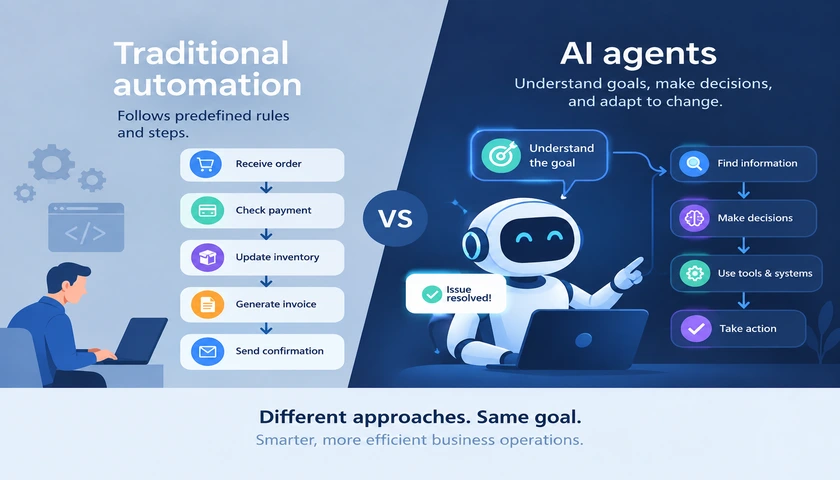
Building a custom, ChatGPT-like application for your business in 2026 is no longer about proving the tech works—it’s about moving from a “generic wrapper” to a proprietary asset. Off-the-shelf bots often fail because they lack your brand’s specific context, domain logic, and infrastructure guardrails.
To build a version that truly scales, you need to treat AI as infrastructure, not just a feature.
1. The “Small Model” Advantage (SLMs)
In 2026, the trend has shifted away from using the largest model possible for every task. For business-specific apps, Small Language Models (SLMs) are often superior. They are faster, cheaper to run, and can be hosted on your own private cloud to ensure data sovereignty.
- Why it matters: Unlike general LLMs that behave probabilistically, an SLM fine-tuned on your company’s SOPs and data provides deterministic performance—meaning it follows your business rules every single time without “hallucinating” brand-new policies.
2. Dynamic UI and “A2UI” Protocols
A ChatGPT-like app shouldn’t just be a wall of text. Modern business AI uses Declarative UI (A2UI). Instead of the AI just talking, it should be able to “request” UI components from your design system.
The Workflow:
- User asks: “Show me our Q1 sales performance.”
- The AI doesn’t just type numbers; it sends a JSON payload to your frontend.
- Your app renders a pre-approved, production-ready Chart Component from your design system.
- The Result: You maintain 1:1 visual parity with your brand while giving the AI “hands” to manipulate your data visually.
3. Bridge the Design-to-Code Gap
If you are building this in-house, your biggest bottleneck will be the handoff between AI logic and your UI. By using design tokens (e.g., color-brand-primary instead of #0055FF), you allow your AI to understand your design system’s vocabulary.
Elite Tier Strategy: Use a Figma-to-Code workflow where your AI “reads” your layer tree. This ensures that when the AI generates a new interface or response, it uses your actual code primitives, not a generic approximation.
4. The “RAG” vs. “Long Context” Decision
How does your AI know your business? You have two main paths:
- Retrieval-Augmented Generation (RAG): The AI searches your database (vector DB) for relevant snippets before answering. Best for massive datasets (e.g., thousands of legal documents).
- Long-Context Window: In 2026, models can ingest hundreds of pages at once. For smaller businesses, you can simply feed your entire project codebase or handbook into the prompt context for near-perfect accuracy without the complexity of a vector database.
Tech Stack Comparison for 2026
| Component | The “Buy” Approach | The “Build” Approach (Elite) |
| Model | OpenAI / Anthropic API | Fine-tuned SLM (Mistral/Llama) |
| Data | Copy-paste into “GPTs” | Private RAG Pipeline / Vector DB |
| UI | Basic Chat Interface | A2UI (Component-native rendering) |
| Security | Third-party cloud | Private VPC / On-prem |
| Updates | Manual prompt tweaks | Automated Guardrail testing |
Key Takeaway: Don’t Build a Chatbot, Build a Workflow
The most successful business AI apps in 2026 don’t just “chat”—they perform tasks. Whether it’s an internal tool that generates production-ready code or a customer-facing portal that builds personalized dashboards on the fly, the value lies in the integration.