Businesses handle several repetitive activities every day, including managing customer enquiries, updating records, processing documents, and preparing reports. These tasks often consume valuable employee time and slow down daily operations.
AI agents offer a smarter approach to automation. They can understand instructions, retrieve business information, make decisions within defined boundaries, and perform tasks through connected applications.
By using AI agents for business process automation, organizations can reduce manual work, improve efficiency, and simplify complex workflows.
What is AI business process automation?
AI business process automation uses artificial intelligence to perform business activities that traditionally require manual effort.
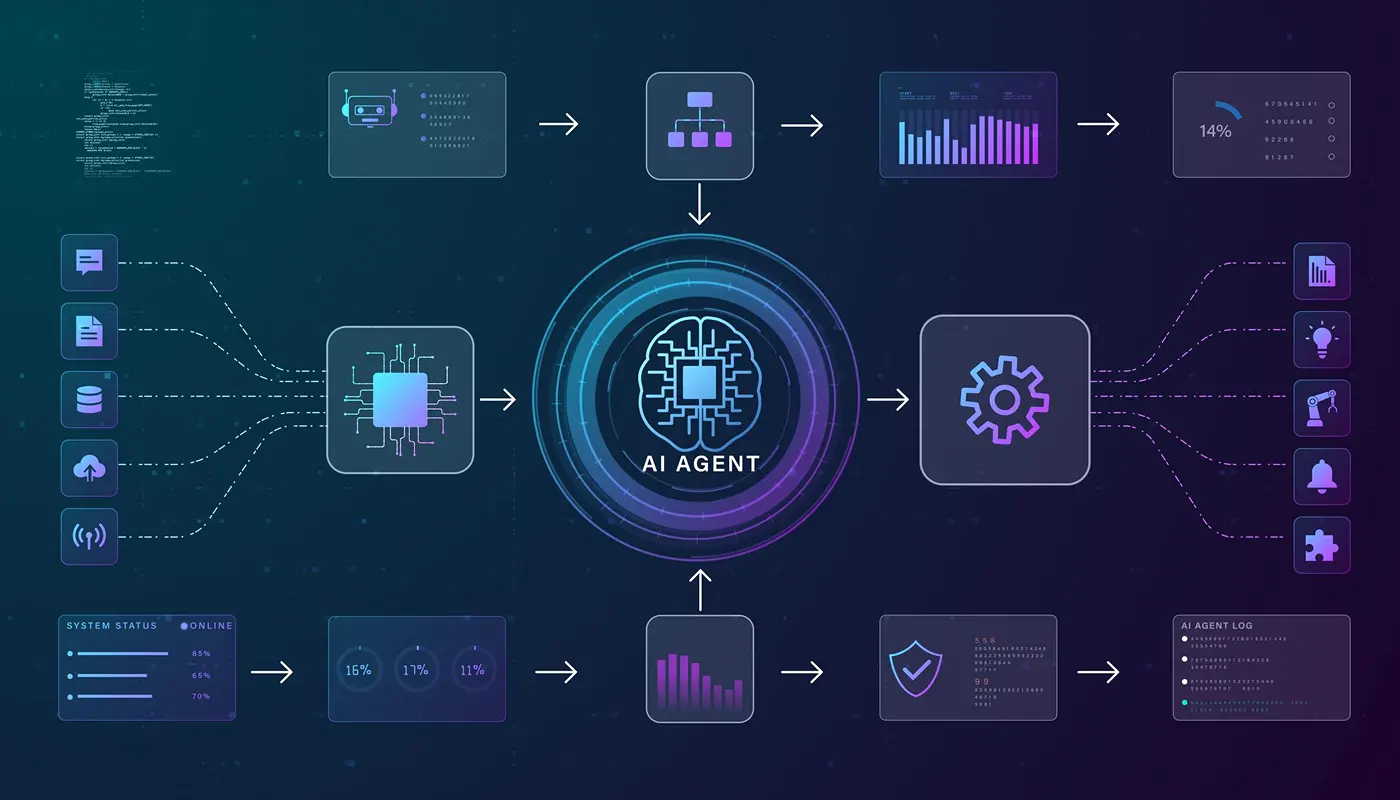
AI agents can understand requests, collect relevant information, plan actions, and execute tasks using connected tools and applications.
For example, when a customer submits an enquiry, an AI agent can understand the request, retrieve customer details, categorize the enquiry, create a support ticket, and route it to the appropriate team.
Unlike traditional automation, AI agents can work with less structured information and handle multi-step tasks based on context.
How do AI agents automate business processes?
AI agents generally follow a structured process to complete business tasks.
- Understand the task: Receive and interpret instructions from employees, customers, or business systems.
- Collect information: Retrieve relevant data from databases, CRM platforms, documents, and other applications.
- Plan actions: Identify the steps required to complete the task.
- Execute tasks: Use APIs and connected tools to perform approved actions.
- Review results: Check task completion and identify errors or missing information.
- Share outcomes: Provide a summary or escalate issues that require human attention.
This approach allows businesses to automate multiple connected activities instead of handling each task separately.
Business processes you can automate using AI agents
AI agents can support different departments by simplifying repetitive work and coordinating business activities.
1. Customer support
AI agents can understand customer enquiries, retrieve product information, check order details, create support tickets, and prepare responses.
For example, an e-commerce business can use an AI agent to handle routine order-status enquiries and escalate complex issues to support representatives.
2. Sales and CRM management
Sales teams can use AI agents to collect lead information, categorize enquiries, retrieve customer history, prepare follow-up emails, and update CRM records.
This helps sales representatives spend less time on administration and more time engaging with potential customers.
3. Finance and accounting
AI agents can assist with invoice data extraction, expense organization, payment reminders, and financial report preparation.
They can also identify missing information and flag discrepancies for human review.
4. Human resources
HR teams can automate employee onboarding tasks, document collection, interview scheduling, policy-related enquiries, and internal reminders.
5. Marketing
AI agents can support content planning, campaign reporting, audience research, performance summaries, and marketing workflow coordination.
6. IT support
AI agents can categorize support tickets, search technical documentation, suggest troubleshooting steps, and route issues to the appropriate teams.
Sensitive system changes should always follow appropriate approval procedures.
AI agents vs. traditional automation
Both approaches reduce manual work, but they handle business processes differently.
| Traditional automation | AI agent automation |
|---|---|
| Follows predefined rules | Understands instructions and context |
| Works best with predictable tasks | Handles more flexible, multi-step tasks |
| Depends on configured conditions | Can select from authorized actions |
| Limited adaptability | Can respond to changing information |
For example, traditional automation can send an email after a form submission. An AI agent can understand the enquiry, categorize it, retrieve relevant information, and prepare a personalized response.
Not every process requires AI. Simple, predictable workflows may still be better suited to traditional automation.
Benefits of AI-powered business automation
Implementing AI agents can help organizations improve everyday operations.
- Reduced manual work: Automates repetitive administrative activities.
- Improved efficiency: Coordinates tasks across different departments.
- Faster information access: Retrieves relevant data from connected systems.
- Better workflow management: Reduces unnecessary delays and manual handoffs.
- Scalable operations: Supports increasing workloads as business requirements grow.
- Employee productivity: Allows teams to focus on higher-value responsibilities.
The actual benefits depend on workflow design, data quality, and implementation.
How to implement AI agents in your business
A successful AI automation project starts with identifying the right business processes.
Step 1: Identify repetitive tasks
Find activities that involve frequent data entry, document processing, information retrieval, or routine communication.
Step 2: Define your objectives
Decide what you want to improve, such as customer response time, lead management, or invoice processing.
Step 3: Evaluate existing systems
Identify the CRM, ERP, databases, and other applications the AI agent needs to access.
Step 4: Choose the right technology
Select suitable AI models, agent frameworks, APIs, and cloud infrastructure based on your requirements.
Step 5: Develop and test the solution
Build the agent, connect the required applications, and test it using realistic business scenarios.
Step 6: Deploy and monitor
Start with a limited workflow, measure performance, and improve the solution before expanding automation.
Technologies used in AI business automation
AI-powered automation solutions combine different technologies to understand information and perform tasks.
- Large language models (LLMs): Help agents understand instructions and generate responses.
- AI agent frameworks: Coordinate reasoning, tool usage, and task execution.
- APIs: Connect agents with CRM, ERP, and other business applications.
- Retrieval-augmented generation (RAG): Helps agents retrieve relevant information from company documents and knowledge bases.
- Cloud platforms: Provide hosting, computing, and storage infrastructure.
- Databases: Store the business information required for automation.
Choosing the right technology depends on the complexity, security, and integration requirements of the project.
Challenges to consider before implementation
AI agents can improve business operations, but organizations should plan for a few important challenges.
- Data quality: Incomplete or outdated information can affect results.
- Security: Agents need controlled access to sensitive business data.
- Integration: Existing or legacy applications may require custom development.
- Accuracy: AI-generated outputs should be validated before important actions.
- Monitoring: Regular performance checks are necessary to identify errors.
- Human oversight: Financial transactions and other sensitive decisions should require suitable approval.
A well-designed solution should balance automation with security, reliability, and human control.
Frequently asked questions
What are AI agents in business automation?
AI agents are intelligent systems that understand tasks, retrieve information, and use connected applications to complete business activities.
Which business processes can AI agents automate?
They can support customer service, sales, CRM management, finance, HR, marketing, IT support, and business reporting.
Can AI agents integrate with existing business software?
Yes. They can connect with existing business applications through APIs and supported integrations.
Are AI agents suitable for small businesses?
Yes. Small businesses can start with focused tasks such as customer enquiries, lead management, and document processing.
Do AI agents replace employees?
AI agents are primarily used to support employees by reducing repetitive work. Human judgment and supervision remain important for complex decisions.
Conclusion
AI agents are changing how businesses manage repetitive activities and coordinate daily operations. From customer support and sales to finance and HR, they can simplify workflows and reduce manual effort.
However, successful AI business process automation requires the right technology, reliable data, secure integrations, and proper monitoring.
Businesses should begin with practical automation opportunities and gradually expand as they see measurable results.
Ready to automate your business operations?
Discover how AI-powered automation can simplify workflows, connect your business applications, and improve operational efficiency. Build solutions around your organization’s specific requirements.